
For many people, downsizing is about more than moving into a smaller home. It is a chance to create a living environment that better supports their current needs, priorities, finances, and lifestyle. A smaller home may require less maintenance, reduce monthly expenses, improve accessibility, and provide more time for the people and activities that matter most.
Even when downsizing makes practical sense, getting started can feel overwhelming. Every room may hold years of belongings, memories, unfinished projects, and decisions. The process becomes easier when it is approached gradually and with a clear purpose. Recognizing the following five signs can help you determine whether it may be time to begin.
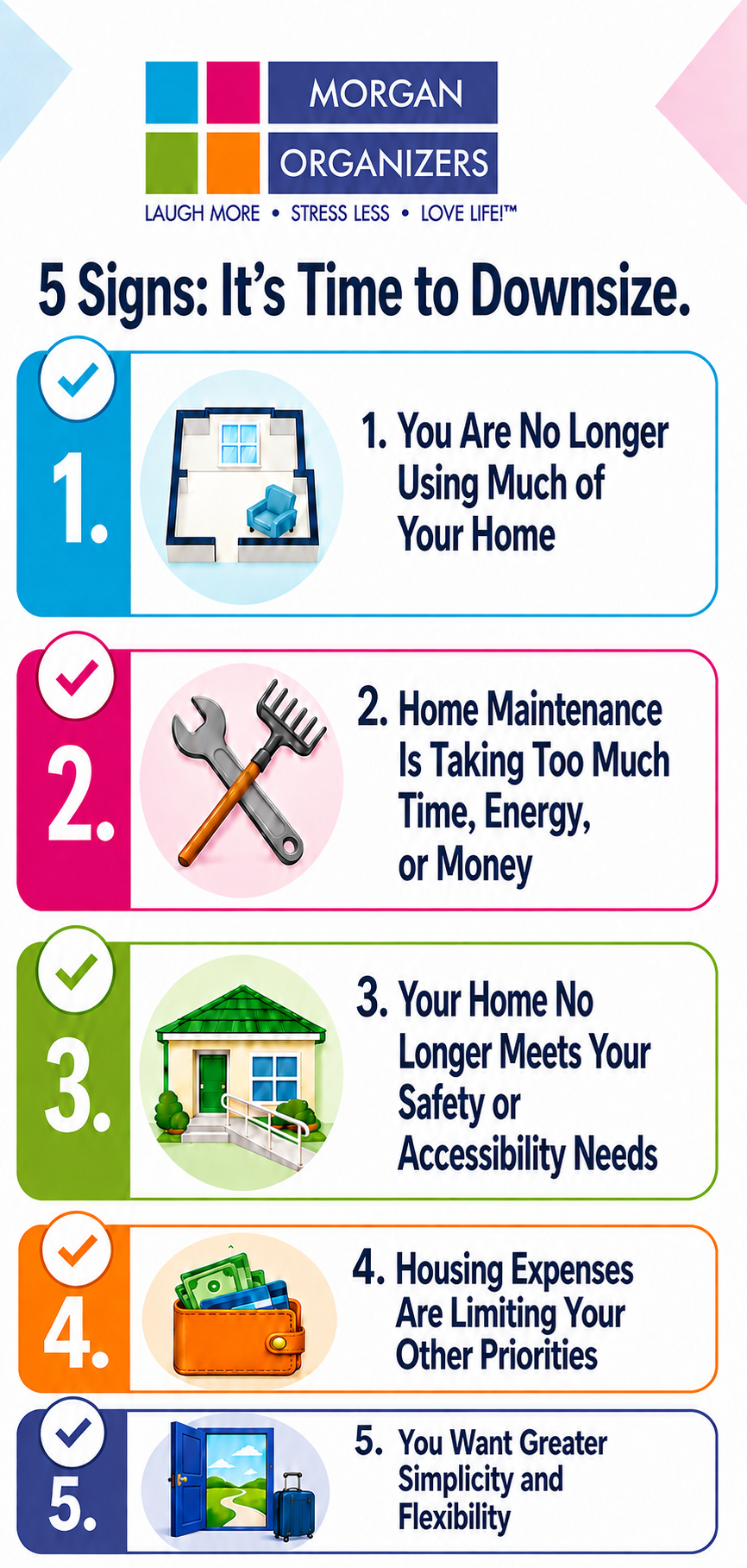
1. You Are No Longer Using Much of Your Home
A home that once fit your household perfectly may now include rooms that are rarely used. Perhaps your children have moved out, the formal dining room is opened only during the holidays, or several bedrooms have become storage spaces. You may find yourself spending most of your time in only a few areas, such as the kitchen, living room, bedroom, and bathroom.
Consider Linda and Robert, who raised three children in a four-bedroom home. After their children established homes of their own, Linda and Robert continued living in the house for more than a decade. They eventually realized that they used only the main bedroom, kitchen, family room, and one bathroom. The other bedrooms were filled with outgrown furniture, boxes of school papers, and items their children had left behind.
Their home was not necessarily too large, but it no longer matched how they lived. Downsizing to a two-bedroom condominium gave them the space they regularly needed, along with a guest room for visiting family. It also eliminated the responsibility of maintaining several unused rooms.
If large portions of your home are primarily serving as storage, it may be helpful to ask whether you still need the space—or whether you simply need a plan for the belongings inside it.
2. Home Maintenance Is Taking Too Much Time, Energy, or Money
Every home requires upkeep. As a house and its major systems age, however, maintenance can become more frequent and expensive. Lawn care, snow removal, cleaning, painting, plumbing repairs, roof replacement, and heating and cooling costs can place growing demands on a household.
For example, James had always enjoyed caring for his yard. Over time, mowing the lawn began taking most of a Saturday, and clearing snow became physically difficult. He hired people to help, but the combined cost of lawn care, snow removal, gutter cleaning, and household repairs continued to rise. He realized that he was spending a substantial amount of money maintaining features he no longer used or enjoyed.
Moving to a smaller townhome reduced both the physical work and the number of unexpected repairs. James did not have to give up gardening completely; he created a container garden on his patio. Downsizing allowed him to keep an activity he valued without maintaining an entire property.
Maintenance needs do not have to become an emergency before you consider a change. If caring for your home is regularly preventing you from traveling, socializing, resting, or pursuing other interests, downsizing may help restore a healthier balance.
3. Your Home No Longer Meets Your Safety or Accessibility Needs
A familiar home can gradually become difficult to navigate. Stairs, narrow doorways, high cabinets, slippery bathrooms, uneven sidewalks, and laundry rooms located in basements may create challenges after an injury, illness, or change in mobility.
Maria began thinking about downsizing after knee surgery made the stairs in her two-story house difficult to manage. Her bedroom was upstairs, while the laundry area was in the basement. Completing one load of laundry required her to travel two flights of stairs several times. Although she recovered from surgery, the experience caused her to think carefully about what would happen if her mobility changed again.
Maria chose a smaller one-level home with a walk-in shower, wider hallways, and laundry facilities near the bedroom. She moved before the situation became urgent, which gave her time to compare options, sort her belongings thoughtfully, and choose a community she liked.
Preparing for future needs does not mean assuming that a problem will occur. It means creating a home environment that remains practical under a wider range of circumstances. Downsizing proactively also gives you more control over where you live and which belongings accompany you.
4. Housing Expenses Are Limiting Your Other Priorities
A larger home often carries larger expenses, including property taxes, insurance, utilities, maintenance, and repairs. Even when a mortgage has been paid, these continuing costs can take up a significant part of a household budget.
David and Sharon wanted to visit their grandchildren more often, but the cost of maintaining their house left little room for travel. During one year, they replaced the furnace, repaired part of the roof, and paid to remove a damaged tree. None of these expenses was unusual for an older home, but together they caused the couple to reconsider how they wanted to use their money.
They eventually moved into a smaller house with lower utility and maintenance costs. Downsizing did not eliminate every housing expense, but it made their monthly costs more predictable and allowed them to set aside money for travel.
Before making a decision, compare the full costs of your current home with the projected costs of another living arrangement. Include taxes, insurance, association fees, utilities, moving costs, repairs, and services that may be included in a condominium or senior community. A smaller home is not automatically less expensive, so a complete comparison is important.
5. You Want Greater Simplicity and Flexibility
Sometimes the clearest sign is not a problem with the house. It is a change in what you want from daily life. You may want to travel, live closer to family, relocate near medical services, spend less time cleaning, or simply own fewer things.
After retiring, Ellen wanted to take longer trips without worrying about her house. Before every departure, she arranged lawn care, asked a neighbor to collect the mail, checked the basement for water problems, and worried about whether something would go wrong while she was away. She added cameras to some of the rooms in her house so she could monitor problems, should they occur, but that gave her little relief from worry. A smaller condominium with exterior maintenance and security features gave her greater freedom to travel.
For another person, simplicity might mean moving closer to grandchildren or into a walkable neighborhood near stores and community activities. Downsizing is not only about reducing square footage. It can also be about choosing a location and lifestyle that make everyday life easier.
How to Begin Without Becoming Overwhelmed
Once you decide to explore downsizing, resist the urge to sort the entire house at once. Begin with one small, emotionally neutral area, such as a bathroom cabinet, linen closet, or kitchen drawer. Completing a limited space builds momentum without requiring hours of work.
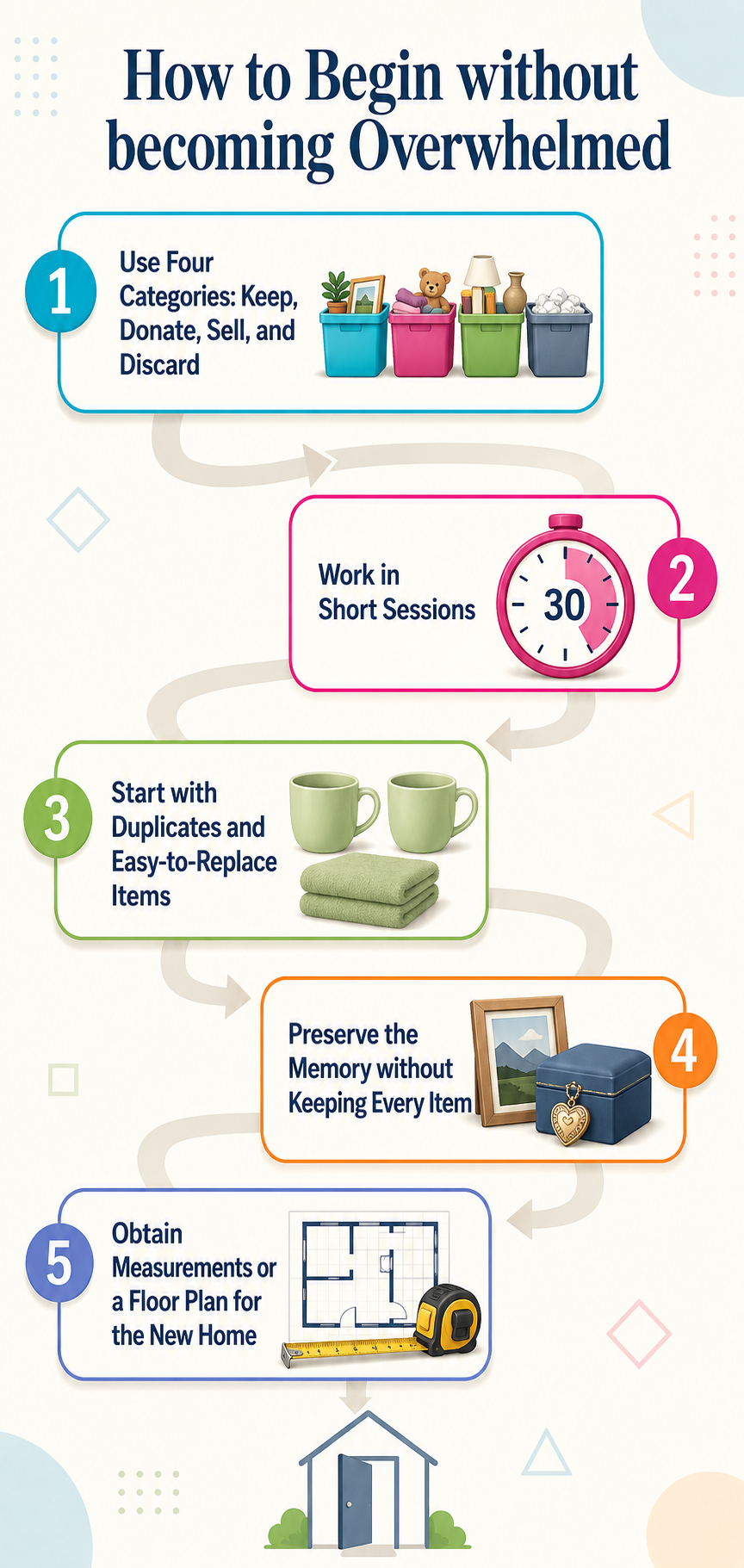
Use four basic categories: keep, donate, sell, and discard. Add a separate “belongs to someone else” category for items your adult children, relatives, or friends have left in your home. Give those individuals a reasonable deadline to retrieve what they want. This prevents their belongings from remaining your long-term responsibility.
Work in short sessions. Thirty minutes of focused sorting can be more productive than an exhausting day that leaves you reluctant to continue. Set a timer, complete one defined area, and stop at the planned time. Regular sessions create steady progress.
Start with duplicates and items that are easy to replace. Extra coffee mugs, towels, tools, plastic containers, and unused kitchen utensils usually involve fewer emotional decisions. As your decision-making becomes easier, move on to books, clothing, furniture, photographs, and keepsakes.
When sorting sentimental possessions, remember that keeping every item is not the only way to preserve a memory. You can photograph a meaningful object, create a small memory box, pass an heirloom to a family member, or write down the story connected with it. The goal is not to remove everything. It is to select the belongings that best represent the people, experiences, and traditions you want to carry forward.
It also helps to know where you are going. If possible, obtain measurements or a floor plan for the new home before deciding which furniture to keep. A dining table may be meaningful, but if it will not fit comfortably, that information makes the decision more concrete.
Finally, ask for help when the process becomes physically or emotionally difficult. Family members, friends, professional organizers, estate-sale companies, movers, and donation services can assist with different parts of the transition. Clear roles are important. One person might pack, another might deliver donations, and a professional might develop the overall plan.
Downsizing does not need to happen quickly or all at once. When you begin early, work in small sections, and make decisions according to the life you want next, the process becomes more manageable. The objective is not simply to move into a smaller home. It is to create a home that supports your safety, financial priorities, independence, and quality of life.